
Why do we forget things right before an exam?
A problem faced by most students explained.


We all know how we suddenly forget everything right before or during a big test. One moment, our mind is a library of well-ordered facts and the next its completely blank. People commonly treat it as a mystery but if we view our mind as a dynamical system, it becomes a predictable trajectory in a defined state space.
If we model the interactions between stress, retrieval from memory and our accessible memory as a system of coupled differential equations, we can finally answer the question a lot of us have, “Why do we suddenly remember things right after the exam?”
State Spaces
Let the mental state of a student at time t be represented in R³, where the components are :
S(t) ≥ 0 : Current stress level
M(t) ∈ [0,1] : Accessible memory that can be recalled
R(t) ∈ [0,1] : Recall efficiency
While the total knowledge stored in long-term memory may be constant, the accessibility of that knowledge is dynamic. We want to see the evolution of this vector over the duration of an exam.
Governing Equations
Stress Equation
αT(t) is the time pressure profile, it represents the time to exam and increases as the exam approaches and during the exam where α > 0 shows how sensitive a student is to time pressure. Here T(t) is a piecewise function defined as:
\( T(t) = \begin{cases} k(t), & t < t_{\text{end}} \\ 0, & t \ge t_{\text{end}} \end{cases} \)-βS is natural calming, it represents how quickly stress decays on its own. Larger beta means the student has a tendency to calm down faster.
-γR is the confidence regained from every successful recall from memory.
-μE, E ∈ [0,1] summarizes the previous performance in the course.
Recall Relation
ρM term represents how easy it is for us to recall stuff from accessible memory.
exp(-ks) represents how stress affects how well we can recall. This term models the Yerkes-Dodson Law of arousal. While a small amount of stress is necessary for alertness, the exponential decay represents the “catastrophic” drop-off point where high arousal leads to a total collapse of performance. This transforms the gradual decline into the sudden “blanking” experience described by students
-δR adds the human element, we cannot sustain a good recall indefinitely without fatigue.
Accessible memory equation
-ηSM shows how accessible memory is dependent on the current stress levels and how high levels of stress block memory access.
λR(1-M) represents how recalling something creates a chain and helps us remember more.
The Attractors and their geometry
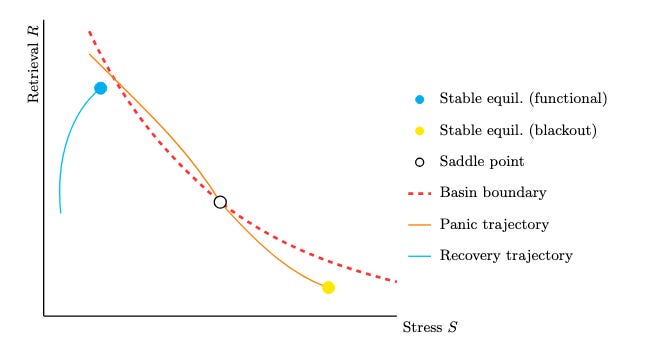
The power of this model can be seen in its phase portrait. By looking at the nullcines (curves with S’=0 and R’=0) the system turns out to be bistable. In an exam environment there are two competing attractors.
Functional Attractor: A state of low stress and high recall, this is the flow state every student wants and is perfect for a testing environment
Blackout Attractor: A state of high stress and extremely low recall, something that is often experienced by students. High stress blocks memory retrieval, creating a sticky zone of no recall.
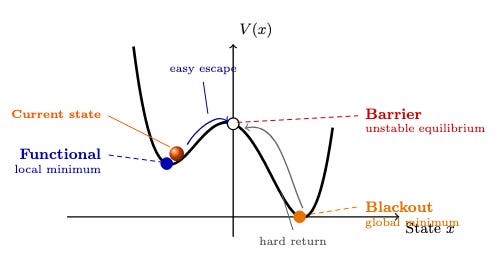
As time goes on, the time pressure parameter changes the geometry of the space. The basin of the functional attractor gets shallower and the well of the blackout attractor gets deeper.
A single question can be enough to give the necessary push required to send the state vector from the boundary between the two basins. Once the boundary is crossed, you are no longer choosing to forget, rather the internal gravity of the system forces you. Even if you stop trying that particular problem, you are still stuck in a state of high stress and zero recall.
This state is sticky due to hysteresis. Since the attractor is stable, simply calming down is not sufficient to return to the functional state and you are stuck in a local minimum. To cross the boundary back into the functional state one must fundamentally perturb the system like shift one’s attention.
Why does the blackout end?
The most frustrating part of a blackout is that we suddenly remember everything the second we walk out of the room. This isn't a coincidence; it is the result of a bifurcation triggered by the end of the exam.
When the clock hits 0, the primary driver of stress in our system (the time profile) abruptly drops to zero. This change fundamentally alters the geometry of the state space. Mathematically, the blackout attractor can only exist under high values of T(t). Once that vanishes, the blackout well disappears entirely. The only stable equilibrium left is that of rest.
This sends us on a recovery sequence
Stress decay - with T(t) gone, Stress (S) begins an exponential decay to zero.
The memory gates open - as stress drops, the exponential suppression term in the recall equation vanishes.
Instant recovery - the gates in the memory equation swing open and the accessible memory M(t) recovers almost instantly.
This shows that the information was never forgotten by us. Instead, the topography of our mind was warped by the time pressure creating a trap that could be broken only by a change in the external parameters.
Navigating the space
The existence of a Blackout attractor implies that an exam is also a problem of control theory apart from the standard test of ”knowledge”. We are essentially the pilots of a state vector and we have to try and keep it from crossing the boundary into the dead zone.
This raises a question, how do we mathematically escape a stable equilibrium that is actively resisting our efforts? The differential equations we wrote earlier points us to the way that answers the question.
The write anything strategy
In a blackout state, recall is zero and the system is locked. The most common thing people try to do ”to just remember” fails and it increases stress which ends up deepening the attractor well. Instead one can just write down something/anything. It gives a stochastic perturbation to the system. It forces a non zero value of R, if you look back at the equation even if the exponential term is tiny, manually inserting a value of R creates a spark. Even a small value of R causes the value of ˙S to be negative. As stress drops, the exponential term begins to grow and it forms a positive feedback loop. The nudge doesn’t need to be correct to work, it just needs to be sufficient enough to push the state vector beyond the boundary into the Functional Attractor’s basin.
Psychological control
Another way would be to target the dampening factor. The βS terms represents the decay rate of stress. Through calming techniques, one can artificially change the values of β. If we make it large enough, the blackout attractor may disappear entirely. In this state, the blackout is no longer a stable equilibrium, the only path the math will then allow is a return to the Functional Attractor.
“Stress-Debt”
For the ”traumatized student” (the one who has had a bad performance in the course in the past) the state vector already begins dangerously close to the border. In such cases, one can try to cognitively re-frame the situation and think of it like a challenge or a game. It is the mathematical equivalent to adjusting E. By shifting it from negative to positive, the student increases their safety margin and effectively push the border further away, ensuring that the inevitable pushes by the difficult questions aren’t enough to force them into the blackout basin.
Final Remarks
By framing the exam experience as a dynamical system, we move the conversation from pathology to mechanics. An exam blackout is not a sign of intellectual inferiority or a lack of preparation; rather, it is a predictable state transition; a bifurcation governed by a specific set of parameters.
When we visualize the mind as a potential landscape, we realize that “knowing” the material is only half of the challenge. The stored knowledge remains constant, but its accessibility is a variable dictated by our position in the state space. Success in an exam requires more than just remembering things, it requires the active management of our mental trajectory to avoid the "gravitational pull" of the blackout basin.
Understanding the hysteresis of stress, the fact that it is much harder to climb out of a panic than it is to fall into one allows us to prioritize early intervention. By manipulating parameters like β (calming) and E (cognitive reframing), we can reshape the very geometry of our thoughts and in doing so, we transition from being victims of our biological "glitches" to being engineers of our own cognitive flow.
The mathematical foundations of this phenomenon can be found in Catastrophe Theory (specifically the Cusp Catastrophe), while the psychological underpinnings are detailed in Cognitive Load Theory and the Yerkes-Dodson Law.
Until our paths converge again on a stable manifold, stay centered in your functional basin.
 | A guest post by
|
Wonderful write up Parth though i have few differences coming from the classical Hans Selye psychological model.